





Monday, 8 December 2025
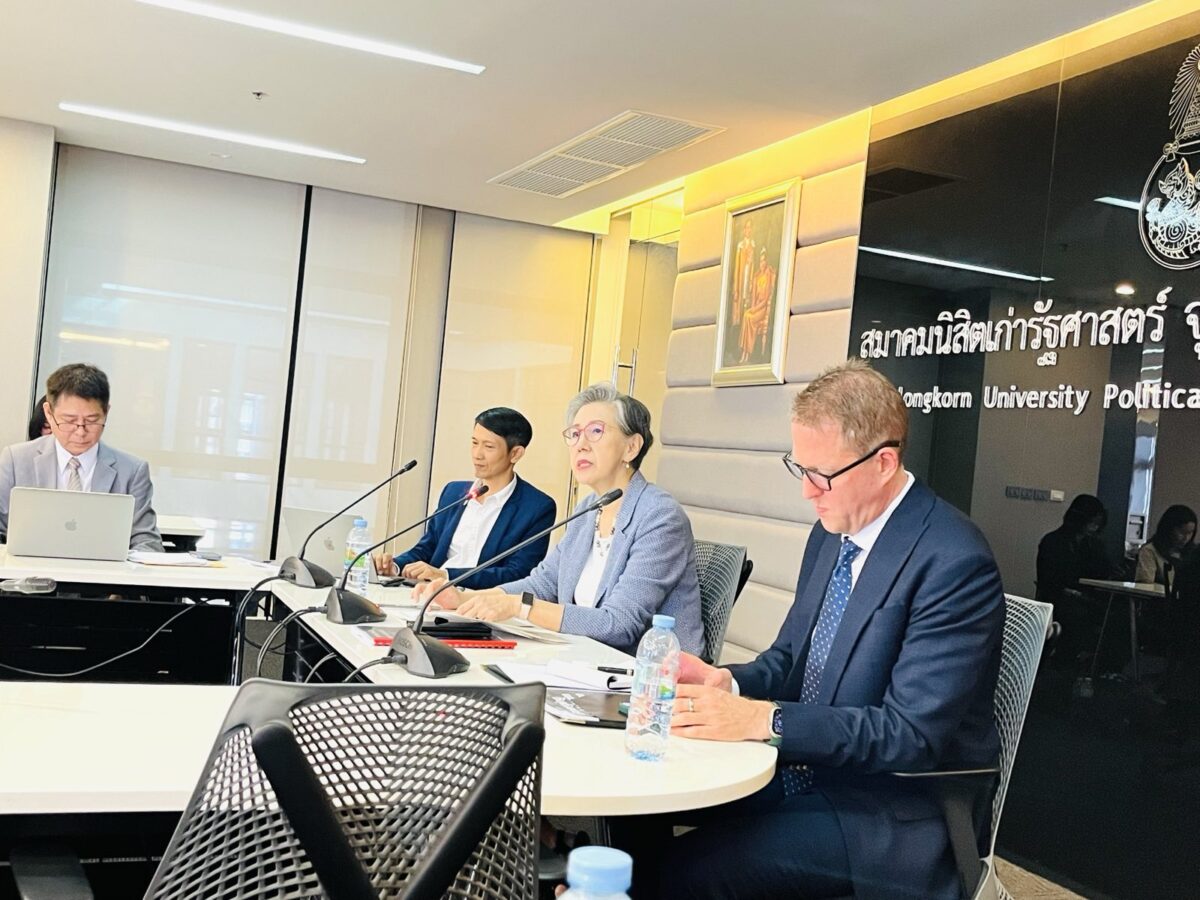
Yanghee Lee delivered the following keynote address at a public seminar to mark Human Rights Day 2025 at the Faculty of Political Science, Chulalongkorn University, Bangkok. The theme of the seminar was “Human Rights, Our Everyday Essentials: Putting People Back at the Center of Myanmar’s Future”.
“Good afternoon,
It is a great pleasure to be invited to mark International Human Rights Day at an institution as esteemed as Chulalongkorn University.
I am very grateful to the UN’s Human Rights Office, We Watch Thailand, the Social Research Institute, Peace and Conflict Research Center, Nelson Mandela Center, and the University’s Faculty of Political Science.
And I thank all of you for giving us your time today.
This year’s Human Rights Day theme is “Human Rights, Our Everyday Essentials”. Yes, we agree that human rights are for everyone and are the basic essentials for everyone. I wonder how many people know what the “everyday” looks like for the peoples of Myanmar. More specifically, do all the peoples of Myanmar enjoy the basic essentials “everyday”? Today, I would like to portray what it looks like “everyday” currently in Myanmar.
Since the military attempted an illegal coup in February 1 of 2021, the peoples of Myanmar have been living in constant fear of the military junta.
Everyday, the people of Myanmar live in, and experience:
- the terror of junta airstrikes and artillery attacks and of homes razed to the ground. Even during the Sagaing earthquake.
- the horror of political imprisonment and the junta’s dehumanising system of torture and sexual violence
- the hopelessness of losing everything to forced displacement
- the pain of hunger
- the fear of having their money and goods taken
- the knowledge that at any moment your son or daughter could be abducted by the junta and forced to fight against their own people.
- nowadays, even older men fear abduction and forced conscription
This has been a lived reality not only for the five years since military’s latest power grab. It has actually been everyday life for the Myanmar people for most of the past seven decades.
I will now turn to our specific focus today – “Putting People Back at the Center of Myanmar’s Future”.
Myanmar has reached a crossroads with two possible ways ahead of it.
One way, the path being pursued by the junta, is the path that will put Myanmarndeeper into crisis. Back to the old days of terror, divide and rule.
The other way, led by Myanmar’s revolutionary federal democracy movement, is the path forward to a new future. It is the embrace of a vision for Myanmar based on peace, justice and human rights.
Through their resistance against tyranny, the overwhelming majority of Myanmar’s people have already made their choice clear. They have chosen freedom and rights. And they stand as an example to the world of what true commitment to democratic values looks like, and the immense sacrifice it demands.
Last week, SAC-M released a new briefing paper entitled Myanmar’s Way Forward. In it, we address and debunk the junta’s sham elections. But more importantly, we present, in their own words, the vision that actors across Myanmar’s revolution have for their nation’s future.
First, I’ll address the junta’s sham elections, slated to begin on 28 December. Our paper, unsurprisingly, finds that these elections would in no way be free, fair nor inclusive. Frankly, they are an absurdity. Who is the junta trying to fool? Logistically, it isn’t even possible, given that the junta controls less than 40 percent of Myanmar’s territory.
But more serious is the junta’s use of extreme violence as an enabler for its elections, including through its intensifying air strikes to terrify civilians and punish perceived opponents and its mass political imprisonment.
The junta’s systematic weaponization of aid as a form of collective punishment also makes it extremely likely that humanitarian assistance will be withheld to coerce communities into participating in the elections against their will. The rights to food, water, shelter, medicine and security are integral to the exercise of fundamental freedoms and, by extension, the right to vote. The right to vote cannot therefore be meaningfully exercised where people lack access to basic necessities or live under threat of violence or displacement.
Then there are the junta’s draconian “laws”, most recently its law on the “Protection of Multiparty Democratic General Elections from Obstruction, Disruption, and Destruction”. It is an abomination in both purpose and grammar. Wow! What a mouthful! It is an abomination of both purpose and grammar.
The “law’s” vague provisions and vindictive application are matched by sentences ranging from three years to the death penalty. Dozens of people have already been arrested, including for acts as trivial as posting emoji reactions to posts criticising the elections.
SAC-M’s report also dispels the myth that sham elections might reopen the limited democratic space as witnessed in the 2010s. Junta leader and alleged war criminal Min Aung Hlaing is driven by a hunger for power so voracious that he happily continues to destroy his own country to achieve his personal ambitions.
It follows that the junta’s sham elections will not provide the “offramp” that the junta’s backers, including China, seek. Instead, the elections will foreclose prospects for dialogue, deepen Myanmar’s political crisis, inflame the conflict and worsen the spiralling humanitarian crisis.
Any legitimization of the junta, including by recognising its elections, is therefore an endorsement for amplified atrocities, instability and flourishing transnational crime, and a green light to future coups within the region.
In stark contrast to the junta, revolutionary actors have presented a common vision for a peaceful and equitable federal Union.
To inform its report, SAC-M sent a questionnaire to the leaders of 41 organisations and key individuals that represent different parts of the revolutionary landscape.
We received responses from 25 organisations including:
- national-level political bodies
- Ethnic Resistance Organisations
- state/federal unit and ethnic-based councils
- coalitions and strike groups, and
- civil society and human rights organisations.
We asked about each organization about their vision for Myanmar and its key ingredients, as well as the actions they are taking and the support they need to achieve it. We also asked them about coordination, trust, the root causes of Myanmar’s conflicts, and the likely impact of the junta’s sham elections.
The responses we received showed a clear coherence around a shared vision for Myanmar’s future.
Despite differences of mandate, constituency, ethnicity and geography, respondents converged around the same ideological, political and structural destination: The creation of a peaceful federal democratic Union that permanently ends military rule, guarantees equality and self-determination for all peoples, and that upholds justice, human rights and civilian governance. This vision is not presented as a reform of the existing Myanmar state, but as its fundamental rebuilding from the bottom up.
Under this revolutionary vision, the federal democratic Union is held together through equality and power-sharing, rather than domination, control and marginalisation.
Respondents presented several interlocking and overlapping ingredients that would together form the structures of an aspirational new federal democracy.
The first is a system of government, established by a new constitution, that permanently ends military rule and guarantees civilian supremacy, including over the military.
Ethnic equality and self-determination are the second ingredient. Respondents consistently pointed to the impacts of longstanding, systemic marginalisation, discrimination, and the persecution of ethnic and religious minorities. Many saw the denial and erasure of the rights and identities of ethnic minorities, driven primarily by the military and central governments, as root causes of conflict and entrenched inequality.
A third ingredient is unity and coordination among revolutionary forces, with unity framed as both a revolutionary means and an end. Respondents repeatedly referred to the need for “dialogue and collaboration” between revolutionary stakeholders, a common framework for decision-making, and an inclusive process that ensures the participation of women, youth and ethnic nationalities.
The fourth ingredient is the realisation of justice, human rights and fundamental freedoms, with gender equality also raised as a core component. Respondents stressed that democracy cannot exist side by side impunity, and that accountability and truth-telling are essential for reconciliation and non-recurrence of violations and abuses. Respondents also linked justice to the restoration of dignity.
So with all that said, what can and should we be doing to help put people back at the center of Myanmar’s future?
Well, respondents helped answer that for us. A striking degree of commonality emerged across the spectrum of revolutionary actors in their calls for international action. They seek:
- formal political recognition of the revolutionary movement and support for its ground-up political processes
- concrete action, including by ASEAN and the UN Security Council, to stop the junta’s atrocities and to secure the release of political prisoners
- diplomatic isolation of the junta, including through the denunciation of its sham elections and the withholding of recognition from the junta in its current and in any future form
- the ramping up of sanctions and embargoes to block the junta’s access to weapons and cash
- an enhanced justice and accountability efforts
- the delivery of desperately needed humanitarian assistance
- principled engagement by ASEAN and UN bodies and entities
- and, as a golden thread through all of these requests, respect for the will of the Myanmar people.
In closing, I want to add some detail to these calls for action.
To ASEAN and its Members –
- state publicly that you outright reject the junta’s sham elections and its outcome and that you will refuse to send observers or to participate in any other way
- build on recent Stakeholder Engagement Meetings by creating a formal ASEAN platform to support legitimate Myanmar representatives in their negotiation of a new federal democratic constitution
- maintain your ban on junta representatives participating in ASEAN meetings and confirm a series of graduating punitive steps that you will take if the junta continues to ignore ASEAN’s decisions, refuses to end its attacks on civilians and to release political prisoners, and continues to withhold and manipulate humanitarian assistance.
To the broader international community –
- prioritise political, financial and technical support to Myanmar’s legitimate democratic actors in ways that respect the will and interests of the people and that involve all communities, including the Rohingya and other minorities
- end and block the sale, transfer and diversion of arms, munitions, aviation fuel and other military equipment to the junta
- impose, strengthen and coordinate financial restrictions on the junta, including sanctions against junta members and military- and crony-owned companies and banks
- support the urgent, impartial and unobstructed delivery of humanitarian and material assistance by all available means to all communities in need in Myanmar, including through cross-border channels, and ensure that aid is not weaponised
- And finally, fully cooperate with the International Court of Justice, the International Criminal Court, the Independent Investigative Mechanism for Myanmar, the UN’s Human Rights Office, and national courts and mechanisms in their efforts to secure accountability.
I cannot emphasise strongly enough the urgency of securing accountability. The cycle of impunity is a catalyst for the repeated waves of tyranny and atrocities that have plagued Myanmar for decades. And Min Aung Hlaing is terrified of being held to account for his crimes. We must therefore make every effort to secure his arrest and prosecution. Rodrigo Duterte needs a cellmate in The Hague, and I say this looking at the Philippines as incoming ASEAN Chair.
Myanmar stands at a decisive crossroads. The junta’s plan to entrench itself through sham elections will not resolve the country’s crisis, because the junta itself is the source of that crisis. And it has been through all of Myanmar’s crises.
The revolution, while still in its foundational stages, represents the only legitimate and viable way forward toward a stable and inclusive Union.
This vision is not theoretical – it is already being constructed from the ground up by a broad ecosystem of revolutionary stakeholders working collaboratively through overlapping platforms and processes to realise shared goals.
Its success will depend not only on the courage and unity of the revolution, but on whether the international community chooses to align its actions with the principles it so often professes – democracy, equality, justice, human rights and the self-determination of peoples.
Only the Myanmar people can decide their future. It is their choice alone to make. But we all bear the responsibility to stand on the side of right.
Thank you.”