





The Australian Broadcasting Corporation (ABC) quotes SAC-M founding member Yanghee Lee in its 17 April article.
By Libby Hogan
17 April 2026
When Sean Turnell, a former economic advisor to Aung San Suu Kyi, was thrown into prison after Myanmar’s military seized power in a coup, he pieced together the commander-in-chief’s character from an unlikely source: his cellmates.
“People I spoke to in prison had been in his same class at the military academy. They said he had always been a very insecure guy, always on the lookout to go one better,” he recalled.
It came as little surprise, then, that Min Aung Hlaing’s ambitions extended to reaching the presidency whatever the cost.
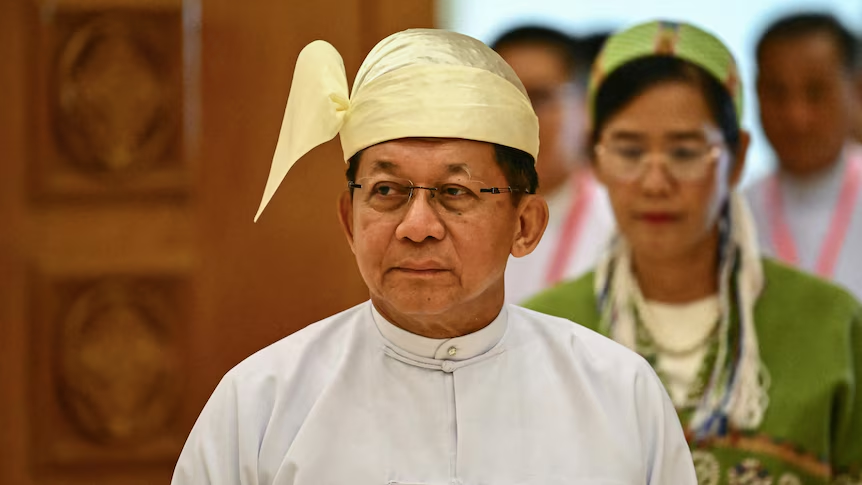
Last Friday, he was sworn in as Myanmar’s president following an election widely condemned as a sham.
Aung San Suu Kyi, the country’s former democratically elected leader, was excluded from the poll.
Mr Turnell was released from prison in late 2022, but five years after the coup that toppled her government, Aung San Suu Kyi remains locked up.
Under Min Aung Hlaing’s command, Myanmar’s military stands accused of bombing civilians, torching villages and committing war crimes against the Rohingya, and investigations are being conducted by the International Criminal Court and the International Court of Justice.
Analysts say Min Aung Hlaing has consolidated power more aggressively than any of his predecessors.
Same general, new clothes
Curtin University associate professor Htwe Htwe Thein warns that if other countries stay silent, it will look like they accept Min Aung Hlaing as president.
“My biggest fear is that the international community — especially those in South-East Asia — will start to recognise and accept him slowly,” Dr Thein said.
“While it may appear a civilian government, it is civilian clothing only, but people may look at the images of parliament sitting and say, ‘Good enough.'”
The election was held in only a third of the country, and the main opposition parties were excluded.
Myanmar has been in a brutal civil war since the 2021 coup.
“The parliament that voted him in was stacked with military loyalists,” Dr Thein said.
She said the first thing Min Aung Hlaing should do is stop the bombing of civilians.
“Even the day after last year’s earthquake, he kept bombing,” Dr Thein said.
Dr Thein said Min Aung Hlaing was following a well-worn playbook used by past military rulers in the country, such as Ne Win, Than Shwe and Thein Sein, by methodically purging anyone whose loyalty was in doubt.
“He kicked out those he didn’t fully trust, or even suspected of disloyalty. He got rid of those with competency because competence threatened him,” she said.
Among his most trusted new appointments is former spy chief Ye Win Oo. Widely known as Min Aung Hlaing’s “eyes and ears”, he now heads the military.
“[Ye Win Oo is] a dangerous figure who has spent a lot of time purging a lot of people,” Mr Turnell told the ABC.
Military buying Thai mansion, investigators say
While Min Aung Hlaing was ordering air strikes, his family was quietly acquiring luxury property in Bangkok, according to investigators.
In 2022, a 98 million baht ($4.3 million) mansion in the Thai capital was purchased through a structure that, on paper, appears legal, but which investigators allege may have been designed to circumvent sanctions.
The ownership is linked to a company registered under a business category unrelated to real estate, which investigators say could obscure the identity of the true buyers.
The deal was reportedly brokered by Tun Min Latt, a well-connected junta associate, who is said to have negotiated directly with Thai developer Charn Issara and moved funds through multiple Thai banks, according to activist group Justice for Myanmar, which uncovered the money trail.
“Under Thai law, there are multiple grounds for asset seizure — authorities could act immediately if there was the political will,” Justice For Myanmar spokeswoman Yadanar Maung said.
“Acts of corruption constitute a predicate offence under Section 3 of Thailand’s Anti-Money Laundering Act, even if committed overseas, and the law provides grounds for seizure by the state.”
US-based non-profit The Sentry, which worked alongside Justice For Myanmar, said the pattern was familiar.
“Myanmar junta leaders, like other illicit regimes and corrupt leaders around the world, follow similar patterns: steal wealth through corruption, use family members and corporate entities to launder the proceeds, then conceal and store it in foreign real estate,” said Laura Ferris, a money laundering expert at The Sentry.
She alleged that “in addition to using the Thai banking system to support the junta’s military actions, junta leaders and their family members are using Thai real estate to launder and store the proceeds of their crime”.
The ABC contacted the Department of Business Development, the anti-corruption authority and the securities exchange commission in Thailand, and the Charn Issara Development Public Company, but has not received any responses.
Justice for Myanmar said it had lodged complaints with Thai authorities.
The gaps in sanctions on Myanmar
Western sanctions designed to isolate Min Aung Hlaing’s inner circle following the 2021 coup have been imposed, but gaps remain.
His children Aung Pyae Sone and Khin Thiri Thet Mon are sanctioned by the United States and Canada, but analysts say sanctions on extended family networks remain uneven, particularly across different countries and regions.
Meanwhile, regional Asian governments have largely remained silent on Myanmar.
“Asian countries don’t really go after one another on a human rights basis,” Dr Thein told the ABC.
“They have a history of non-interference.”
The US, UK, EU and Canada have sanctioned at least 179 individuals and 154 business entities.
Australia has imposed sanctions on 21 individuals and seven entities, as well as implementing an arms embargo against Myanmar.
When asked if Canberra would align with allies in applying more sanctions, a Department of Foreign Affairs and Trade spokesperson told the ABC, “Australia sanctions regime leaders responsible for deposing democratically elected leaders and for repression and violence toward the people of Myanmar.”
“[Sanctions] also seek to limit access to funds and military material that enable ongoing violence against the Myanmar people,” they said.
But Mr Turnell said Australia needed to do more, including implementing further recommendations.
“One breakthrough is the Australian Senate Committee on Democracy and Human Rights recommending the sanctioning of Myanmar’s Central Bank — the main financier of the military and its primary vehicle for weapons procurement,” he said.
Former UN Special Rapporteur Yanghee Lee put it more starkly.
“The international community needs to get off the fence by fully backing the people’s genuine will and ostracising the junta in its current [form] and any future form it takes,” Ms Lee said.
She has called for countries to work with the parallel government, the National Unity Government, and to isolate Min Aung Hlaing.
Mr Turnell warned of the risk of countries falling for the military’s legitimisation campaign, which includes hiring PR firms to help with its image.
“I worry, because the Trump administration, as we’ve seen, is always willing to do deals — and I worry they may do a deal for rare earths,” he said.
“There is a low bar for a lot of countries willing to accept the regime just to move past the Myanmar problem. Min Aung Hlaing will do anything to maintain power.”