





Myanmar Now’s coverage of SAC-M’s 16 July report Factory of Death.
In a new report, the Special Advisory Council for Myanmar (SAC-M) calls on the international community to act against Chinese firms supplying designs and material to produce bombs that the Myanmar military uses against its own people
17 July 2025
An organisation of human rights experts published a report this week on alleged Chinese support for the Myanmar military’s arms production, appealing to governments, United Nations (UN) agencies, and others to counteract the use of these arms against Myanmar’s people.
The report by the Special Advisory Council for Myanmar (SAC-M), entitled “Factory of Death”, investigates the Myanmar junta’s arms production process, especially links between the regime’s munitions factories and businesses in China, a longtime supplier of weapons that have enabled indiscriminate attacks and the killing of civilians by the military.
SAC-M, established to advise the opposition to the military dictatorship in Myanmar following the February 2021 coup, describes its mission as supporting the “peoples of Myanmar in their fight for peace, genuine democracy, justice and accountability.”
The group chose to conduct the investigation as a case study, focusing on just one of Myanmar’s 25 military-owned munitions factories in Magway Region in the country’s heartland. They drew from leaked documents, open sources of information, and personal testimonials to illuminate the extent of China’s support for the regime.
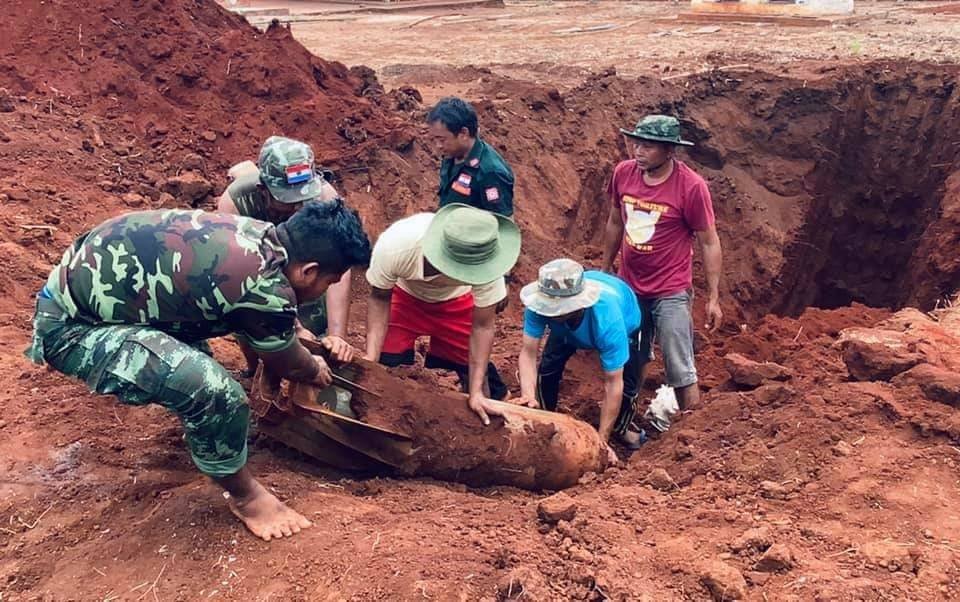
Known as DI 21 (or Ka Pa Sa 21 in Burmese), the factory produces “aerial bombs” used for multiple purposes by the Myanmar military, including air raids. As with all 25 of the military’s arms factories, the DI in its is name refers to Myanmar’s military-controlled Directorate of Defence Industries (abbreviated DI).
“Aerial bombs made at DI 21 continue to be used in airstrikes that likely meet the threshold of serious international crimes,” the SAC-M report said of the factory, an example of what it called the defence industry’s “role in enabling the aerial bombardment…of the country’s civilian population.”
FAE bombs
Between 2015 and 2020, Myanmar’s military used a kind of thermobaric munition called “fuel air explosive” (FAE) bombs in Sagaing Region and Kachin and Chin states on three separate occasions.
SAC-M’s report details how these bombs were either imported directly from China or partially or wholly assembled in the DI 21 factory from imported parts.
250-kilogramme FAE bombs are manufactured by a Chinese state-owned arms company known as the China South Industries Group Corporation (China South, or CS), which first showcased them in 2015 before transferring production to Myanmar for the purpose of supplying the Myanmar air force, according to SAC-M.
“This transfer was likely coupled with a transfer of technology and technical assistance for the production of these bombs and additional aerial bombs in Myanmar,” the report said.
Similarities between the bombs produced in the DI 21 factory and other bombs manufactured and marketed in China South corroborate that their design is Chinese origin, according to SAC-M.
The research group’s findings suggested that the collaboration between the DI and the China South subsidiary Hunan Vanguard “entailed a transfer of technology and associated assistance for DI 21 to set up production of a wide range of aerial bombs.”
Quelling the resistance
With its focused case study tracing the connection between a Chinese-designed technology and a weapon finished at one junta factory for combat use, SAC-M’s investigation illustrated China’s much broader support for the junta’s effort to remain in power through brute force.
While the case study’s scope was the 2015-20 time range, it sheds light on a relationship that continues to enable the junta’s violence against its people and abuse of human rights, which has only intensified over the past four and a half years.
Myanmar has been in turmoil since the military overthrew the civilian-led government of Aung San Suu Kyi’s National League for Democracy party in February 2021. Regime forces have failed to maintain control in multiple parts of the country as they fend off advances by ethnic armed groups and allied resistance forces that emerged in response to the 2021 coup.
In its efforts to subdue the armed resistance and ethnic armed organisations, the junta has carried out indiscriminate airstrikes across the country, also deploying unmanned drones at unprecedented rates, mainly targeting areas populated by civilians.
The report notes that the junta carried out 750 airstrikes across 11 of Myanmar’s 14 regions and states in the last four months of 2023 alone, and that it did not suspend aerial bombing even after the deadly March 2025 earthquake that devastated central Myanmar, killing thousands.
Homes, schools, places of worship, other religious buildings, and crowded marketplaces are frequent targets for the military’s air force, and SAC-M emphasises that the junta’s repeated bombardment of these targets may constitute crimes against humanity, war crimes, or other breaches of international law.
“Companies and corporate executives that provide military support to the Myanmar junta, enable the production of aerial bombs or otherwise facilitate the airstrikes may expose themselves to the risk of criminal and civil liability,” the report says.
Appeals to foreign governments, international organisations
In illustrating how the relationship between Chinese suppliers and the Myanmar military regime enables some of its worst alleged violations of the law and human rights, SAC-M highlighted the need for the international community to act against those states, corporations, and individuals aiding or abetting war crimes.
“SAC-M calls on all governments to take action against the companies identified in this report as enabling the military’s production of aerial bombs,” the report said, specifically naming China South, Hunan Vanguard, and another China South subsidiary.
The research organisation specifically called for blocking the Myanmar military’s access to the micro-electronics and other essential components in the production of aerial bombs.
More generally, SAC-M called on foreign governments to audit their domestic companies’ and individual states’ relations with the Myanmar military to ensure there was no support for its crimes and prosecuting any persons or entities found to be abetting them.
They also called on governments to cooperate with international organisations, agencies, and courts, for which SAC-M had a separate set of recommendations.
Among these were calls for the UN and ASEAN to deliver badly needed aid to Myanmar people whose lives have been devastated by conflict and natural disaster, for the UN Security Council to impose an immediate ceasefire in Myanmar, for the UN General Assembly to recognise the opposition National Unity Government as the legitimate government of Myanmar instead of the military junta.
They also appealed to the International Criminal Court to issue warrants for violators of humanitarian law in Myanmar and investigate people or businesses that might be held responsible as accomplices to those crimes.
“Building a just and peaceful future for all of Myanmar’s peoples requires acting now to end the military’s grave violations and abuses of international human rights and humanitarian law,” the report concluded.
SAC-M has long advocated what it calls a “three cut strategy” for opposing military dictatorship in Myanmar, consisting of methods to “cut the cash,” “cut the weapons,” and “cut the impunity.”